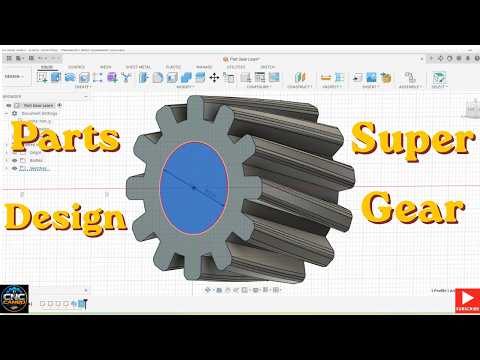
Gears are the beating heart of mechanical machinery, transmitting power and motion across thousands of industrial applications. However, creating high-performance gears with exact tolerances requires accurate software tools and solid technical expertise. Whether you are crafting complex spur gears or intricate bevel gears, mastering modern CNC CAD design is the ultimate key to achieving flawless manufacturing results.
Why Precision Gear Design Matters
In modern manufacturing, traditional manual calculations for gear parameters—such as pitch diameter, pressure angle, and module—have evolved into automated parametric processes. Utilizing advanced software like Autodesk Fusion 360 allows designers to quickly model complex tooth geometries that minimize friction, wear, and noise. Precision at the digital design stage directly translates to superior quality during physical production, preventing costly machining errors down the line.
Key Workflow Steps in Modern CAD and CAM
Creating an optimized gear model requires a structured design approach that seamlessly transitions from a 2D sketch to a 3D physical part. Here is how professional engineers approach the process:
- Parametric Sketching: Define fundamental gear parameters using exact mathematical formulas to generate accurate tooth profiles.
- 3D Feature Generation: Extrude and refine the gear body, adding keyways, weight-reduction pockets, and bore holes.
- Simulation and Optimization: Run stress and motion analyses to ensure the design withstands operational loads.
Using dedicated software for your CNC CAD design streamlines this workflow by integrating both Computer-Aided Design (CAD) and Computer-Aided Manufacturing (CAM) into a single ecosystem. Once the 3D model is finalized, generating precise G-code for your CNC milling or turning machine becomes a seamless, error-free operation.
Bridging the Gap Between Design and Machining
A perfect digital model is only as good as its physical execution. Once your model is completed, CAM toolpaths are generated for your CNC milling machine or lathe. Selecting the right cutting tools, spindle speeds, and feed rates ensures that the finished metal or plastic gear matches your original drawing with micron-level accuracy.
Continuous learning is essential in the fast-evolving field of manufacturing. By consistently honing your skills in CNC CAD design, you can optimize material usage, reduce machining cycle times, and produce professional-grade mechanical components every single time.

No comments:
Post a Comment