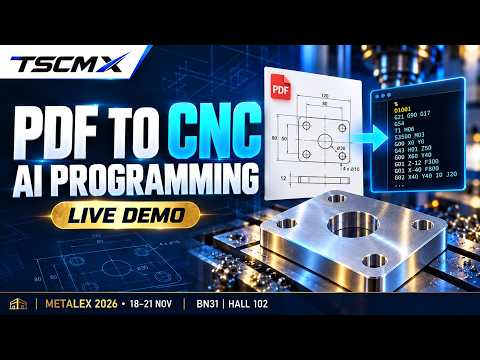
In the fast-paced world of manufacturing, efficiency and speed are paramount. Traditionally, converting technical drawings into actionable G-code required hours of manual interpretation, precise calculations, and meticulous error-checking. However, artificial intelligence is rapidly transforming this workflow. With cutting-edge technology like TSCMX's AI-powered system, machinists can now bridge the gap from a simple PDF drawing to a fully functional CNC program in a matter of seconds.
The Evolution of Machining Automation
For decades, CNC programmers spent valuable hours analyzing 2D blueprints, manually entering coordinates, and setting up complex toolpaths. While traditional CAD/CAM systems improved this process, they still demanded extensive manual input. Today, the integration of artificial intelligence into an advanced CNC software application represents a massive leap forward, drastically reducing setup times and eliminating tedious data entry.
How AI Turns PDF Drawings Directly into CNC Programs
The core innovation behind AI-driven CNC programming is intelligent blueprint analysis and computer vision. Instead of forcing operators to manually input dimensions from a PDF drawing, the system scans the engineering document, recognizes critical geometries, dimensions, and tolerances, and automatically determines the optimal machining strategy.
By leveraging a modern CNC software application equipped with AI capabilities, shop floors can generate precise machine instructions almost instantaneously. This seamless transition from PDF to G-code allows operators to spend less time programming and more time delivering high-quality finished parts.
Key Benefits for Modern Machine Shops
Adopting an AI-powered CNC software application delivers several tangible advantages to modern manufacturing facilities:
- Unmatched Speed: Convert complex PDF drawings into ready-to-run CNC programs in a fraction of the traditional setup time.
- Minimized Human Error: Automated dimension extraction cuts down on costly manual input mistakes and material scrap.
- Optimized Machining Strategies: AI algorithms help select efficient toolpaths, reducing machine cycle times and extending tool life.
- Increased Production Agility: Rapid programming enables shops to handle short runs and prototype jobs much more profitably.
The Future of Smart Machining
The shift from manual coding to automated, AI-driven program generation is revolutionizing shop-floor productivity. By upgrading your workflow with smart automation, your business can maximize machine uptime, reduce labor bottlenecks, and stay ahead in an increasingly competitive industry.

No comments:
Post a Comment