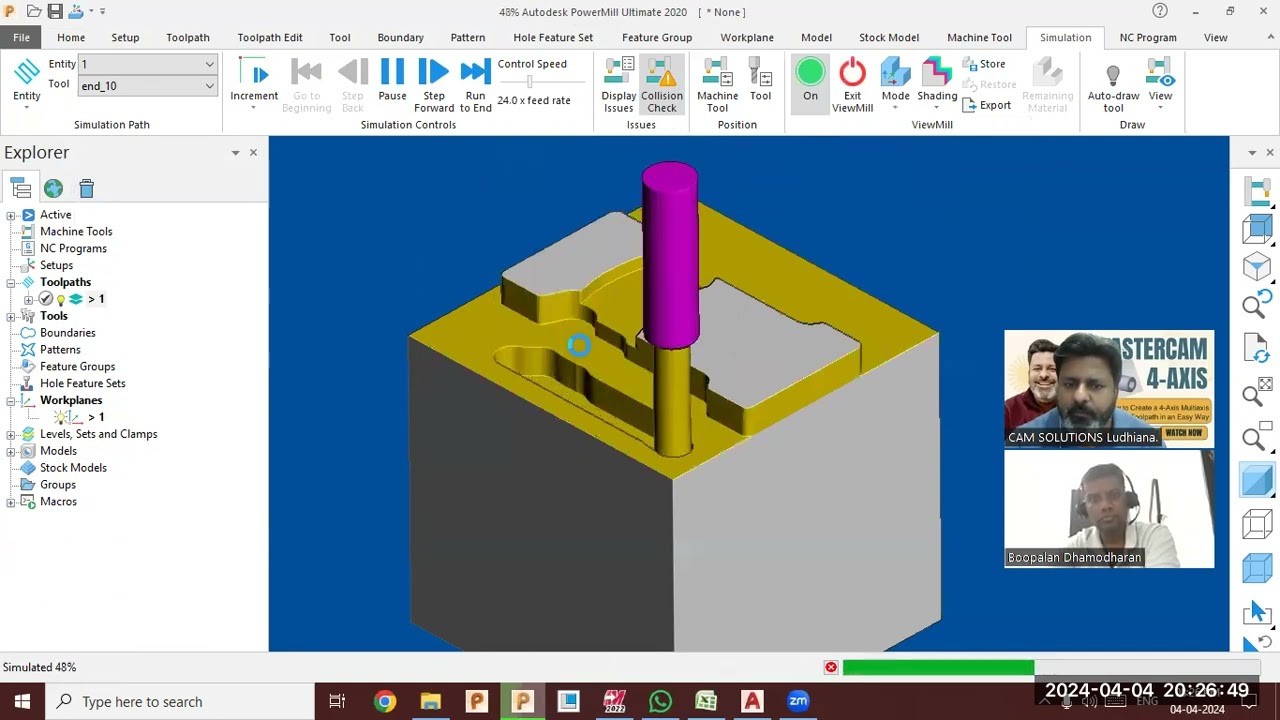
PowerMill Tutorial: Master the 3D Roughing Toolpath for VMC
This article provides an in-depth exploration of Toolpath, covering foundational concepts, practical applications, and engineering insights.
Welcome to Day 2 of our comprehensive PowerMill 3D programming series! Efficient material removal is the foundation of successful CNC machining. In this guide, we dive deep into the Model Area Clearance strategy—the industry standard for 3D roughing on Vertical Machining Centers (VMC).
What is Model Area Clearance?
In 3D CNC machining, roughing is the critical first stage where the bulk of raw stock is rapidly removed before finishing operations begin. PowerMill’s Model Area Clearance strategy allows programmers to calculate safe, highly efficient cutting strategies tailored to complex 3D geometries. Creating an optimized roughing toolpath ensures maximum material removal rates while protecting your cutting tools from premature wear and thermal stress.
Step-by-Step: Generating Your 3D Roughing Toolpath
Setting up your roughing strategy in PowerMill requires a structured approach to achieve optimal cycle times and smooth machine motion:
- Define the Stock and Model: Ensure your 3D CAD model is correctly imported and aligned with your machine setup. Define the workpiece block to accurately reflect your raw material dimensions.
- Select the Right Cutting Tool: For heavy roughing operations, choose a robust end mill or bull-nose cutter capable of handling higher chip loads.
- Configure Area Clearance Parameters: Open the Model Area Clearance menu. Enter key cutting values, including stepdown (axial depth of cut), stepover (radial width of cut), and machining tolerances.
- Calculate and Verify: Generate the 3D roughing toolpath and run a full visual simulation to inspect tool motion, verify lead-ins, and prevent collisions with fixtures.
Best Practices for PowerMill VMC Machining
To maximize shop-floor productivity, consider these essential optimization tips:
- Maintain Constant Tool Loading: Use rounded corners and smooth offset strategies to prevent sudden load spikes during directional shifts.
- Set Appropriate Stock Allowance: Leave a uniform remaining thickness (such as 0.3 mm to 0.5 mm) for semi-finishing and finishing stages.
- Refine Feed Rates: Balance your cutting speeds and feed rates based on material hardness to extend tool life.
Mastering the roughing toolpath in PowerMill is a crucial skill for any modern CNC programmer. By applying these techniques, you can significantly reduce overall machining cycle times while ensuring part accuracy.

No comments:
Post a Comment