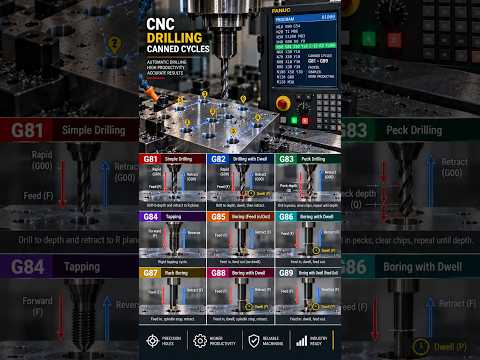
Computer Numerical Control (CNC) machining relies on precise digital instructions to execute cuts, drills, and complex shapes. At the heart of this automated manufacturing system is G-code, the fundamental programming language that directs the machine tool on where to move, how fast to travel, and which path to follow.
Whether you are a beginner machinist or an engineer looking for a quick refresher, understanding these primary commands is key to running efficient operations. Here is a breakdown of the most critical commands you need to know.
Rapid vs. Linear Motion: G00 and G01
Straight-line movements are the backbone of CNC machining. Knowing when to reposition quickly versus when to cut material ensures safety and optimal cycle times.
- G00 (Rapid Positioning): Moves the tool at the machine’s maximum speed to a specified coordinate. This command is strictly used for moving through open air, never while cutting material.
- G01 (Linear Interpolation): Moves the tool along a straight line at a specified feed rate. This is the primary command used for direct cutting moves.
Circular Interpolation: G02 and G03
When your design calls for smooth curves, arcs, or full circular pockets, circular interpolation commands take over.
- G02 (Circular Interpolation - Clockwise): Directs the tool to move along a curved arc in a clockwise direction at a controlled speed.
- G03 (Circular Interpolation - Counter-Clockwise): Directs the tool to move along a curved arc in a counter-clockwise direction.
Positioning Modes: G90 and G91
Before executing movement commands, the CNC machine must understand how coordinate values are measured.
- G90 (Absolute Positioning): Every coordinate value is referenced from a fixed zero point (X0, Y0, Z0). This mode ensures maximum accuracy and minimizes positioning errors across complex programs.
- G91 (Incremental Positioning): Coordinate values are measured from the tool's current location. Each endpoint becomes the starting point for the subsequent move.
Final Thoughts
Gaining confidence in reading and editing G-code starts with mastering these core commands. By understanding how linear motion, circular interpolation, and positioning modes work together, you can optimize toolpaths, troubleshoot errors on the shop floor, and manufacture high-precision parts with ease.

No comments:
Post a Comment