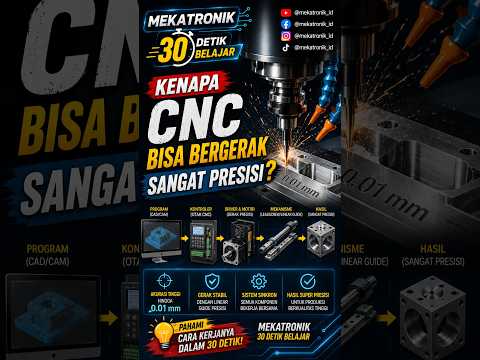
Have you ever wondered how modern Computer Numerical Control (CNC) machines can carve metal, wood, and plastic down to a tiny fraction of a millimeter? From aerospace components to delicate medical implants, these automated workhorses operate with astonishing accuracy. But what exactly allows a CNC machine to move with such extreme precision?
The secret lies in a powerful combination of digital software, smart electronics, and ultra-durable mechanical engineering.
From Digital Blueprint to Perfect Cut: The Role of CAD/CAM
Every high-precision manufactured part starts in the digital world. Engineers first create a detailed 3D model using Computer-Aided Design software. Once the design is ready, modern CAD/CAM tools convert those visual geometries into G-code—the precise mathematical programming language that tells the machine where to move, how fast to travel, and how deep to cut.
Without advanced CAD/CAM solutions, executing complex multi-axis movements with micrometer-level accuracy would be nearly impossible. The software removes human calculation errors, providing a flawless digital foundation for the physical machine to execute.
High-Tech Motors and Precision Hardware
Once the control system receives the digital instructions, the machine relies on specialized mechanical hardware to transform code into precise physical motion:
- Servo and Stepper Motors: Unlike standard electric motors, servo motors rotate in tiny micro-steps. They offer exact control over rotational angle, acceleration, and position.
- Recirculating Ball Screws: Standard screws have mechanical play (backlash) and friction. CNC machines use precision ball screws to convert rotational force into smooth linear motion with virtually zero friction or lost movement.
Closed-Loop Feedback Systems
To guarantee absolute accuracy throughout the cutting process, modern CNC setups use closed-loop feedback systems. Optical encoders constantly read the exact location of the cutting head and transmit position data back to the central controller thousands of times per second. If the system detects even a sub-micron error, it instantly makes real-time micro-adjustments.
Conclusion
Extreme CNC precision isn't magic—it is the result of intelligent mechatronics. By pairing robust mechanical hardware with sophisticated CAD/CAM software, modern automated manufacturing achieves levels of speed, consistency, and micron-level accuracy that drive our modern world forward.


No comments:
Post a Comment